
Root canal treatment removes infected or damaged tissue (the pulp) from inside a tooth, cleans the canals and seals them, so the tooth can often be kept instead of pulled. Success rates are generally high, but the tooth is not finished until it has a lasting restoration, and the treatment is hard to do well in a hurry.
If you are travelling for it, ask who will place the final crown or filling, because delay increases the risk of failure or fracture.
What patients are quoted
We are collecting anonymous quotes for this treatment. Figures appear here once at least ten quotes are in.
Share the price you were quoted. It is multiple choice only and asks for no personal details. How the figures are calculated.
At a glance
- Can it be undone?
- Not reversible, but it aims to save the tooth.
- How long?
- Usually 2 or more visits of 1 to 2 hours (NHS).
- Evidence figure
- About 96% success without root-end inflammation, about 85% with it (Leeds).
- Ask first
- Who places the final crown, and when?
Root canal timeline
- Appointment1 to 2 hours or longer; 2 or more may be needed
- Soreness afterwardsOften 3 to 4 days; flare-up in about 1 to 5% of people
- Final crown or fillingPromptly, by your own dentist
- ReviewPeriodic X-rays; healing can take 6 months to 4 years or longer
Sources: NHS; Leeds Teaching Hospitals NHS Trust.
What root canal treatment is
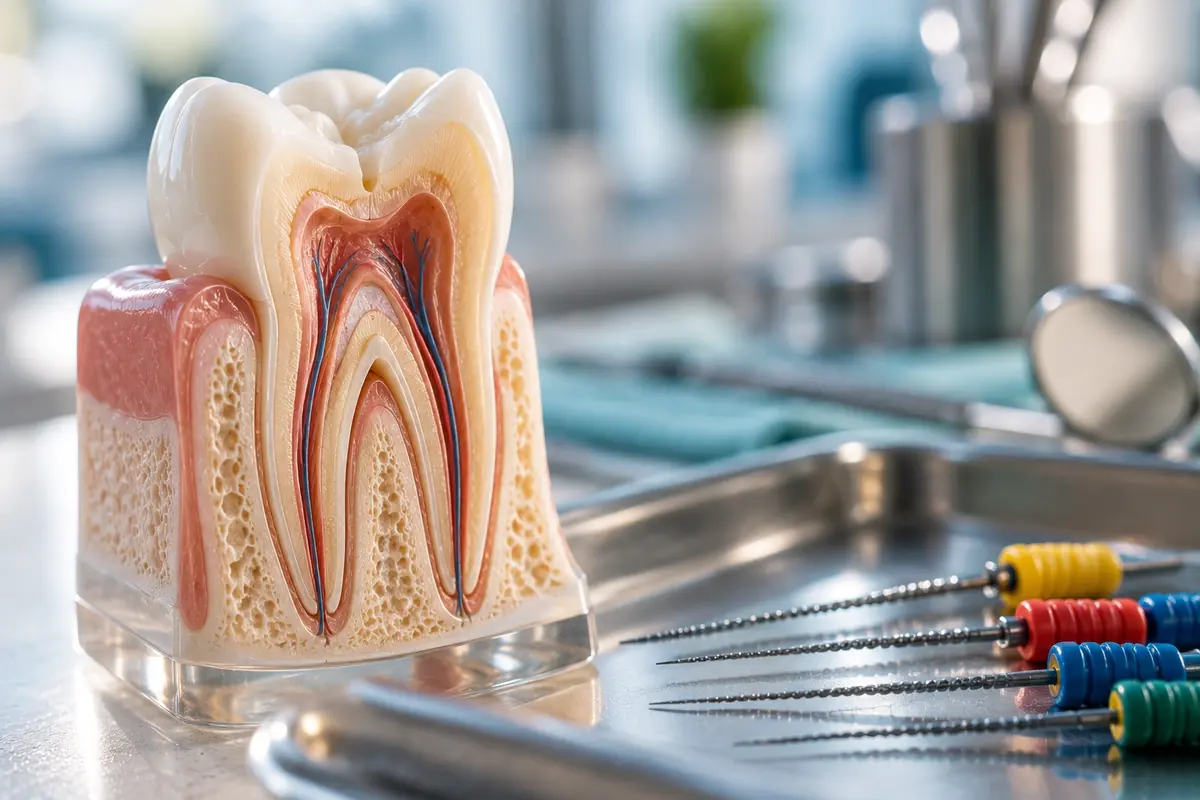
The pulp is the nerve and blood supply inside a tooth. Bacteria can reach it after injury or decay and cause pain or infection such as an abscess. The NHS says root canal treatment is recommended for tooth pain caused by an infected tooth, which can follow decay, gum disease, a chipped, broken or cracked tooth, or a dental abscess.
Leeds Teaching Hospitals lists the usual steps: a rubber dam keeps the tooth dry, the tooth is opened to reach the canals, the canals are cleaned and shaped (often with a microscope), X-rays check length and filling quality, disinfectant is used, and a root filling seals the canals. Your own dentist then places the final filling or crown.
Visits, pain and recovery
- Visits: the NHS says usually 2 or more appointments of 1 to 2 hours or longer. Leeds says appointments last 1½ to 2 hours and complex or heavily infected teeth may need more than one.
- During treatment: pain is rare because local anaesthetic is used. The jaw and face may stay numb for several hours.
- Afterwards: the tooth may be sore for 3–4 days, sometimes longer, and painkillers such as paracetamol or ibuprofen can help. Leeds says flare-ups occur in about 1–5% of people, usually 3–4 days later, and may need antibiotics.
- Healing: the tooth is reviewed with periodic X-rays, and Leeds says healing can take six months to four years or longer.
Success rates and risks
| Question | What Leeds Teaching Hospitals says |
|---|---|
| How often does it work? | About 96% success when there is no inflammation at the root end, and about 85% where inflammation is already present. No guarantee is given. |
| What if it fails? | Re-treatment is possible. Success for re-root canal treatment is quoted at 40% to 80%, depending on the original problem. Other options are root-tip surgery or extraction. |
| What can go wrong? | Incomplete healing; a canal that is missed, blocked or not fully cleaned; a broken instrument in the canal; a perforation of the tooth or root; disinfectant leaking into the mouth or beyond the root tip; later fracture of the weakened tooth; a flare-up between visits. |
| Why the final restoration matters | The tooth must be restored promptly with a crown or filling to protect it. Delay significantly raises the risk of failure or fracture. |
Alternatives: extraction, followed by no replacement, a denture, a bridge or an implant. Not treating the tooth risks pain, swelling, infection, cysts, bone loss and loss of the tooth.
If you are travelling for it
- An infected tooth can be an emergency. If you have swelling, fever or severe pain, see a dentist or emergency service first. Do not wait for a trip.
- Complex teeth take time. Back teeth with several canals, old failed treatments and curved canals are harder. Ask who will do the work (a general dentist or an endodontist) and how many visits are planned.
- Make a plan for the crown. Is the final crown part of the trip, or will your own dentist place it, and when? Agree this before you travel.
- Keep the X-rays. Before and after images are the only way a dentist at home can see how the canals were filled.
- Ask whether the tooth is worth saving. Sometimes extraction and an implant is the better plan, sometimes the reverse. Ask for the reasoning.
Questions to ask before you agree
Tap a question to copy it, then paste it into a message or an email.
Root canal checklist
Tick items off as you complete them. Your ticks stay in this browser only.
Before you book in Türkiye
The same checks apply whichever treatment you choose. Each links to a full guide.
- Check the authorisation. Make sure the clinic, and any agency, holds a Ministry of Health authorisation for international patients. How to verify it
- Get the plan in writing, tooth by tooth. It should name the treatment, materials and brands for each tooth, and the full price. Questions to ask
- Read the guarantee before you pay. Find out what it covers, for how long and who pays for travel if something needs fixing. Guarantees
- Know what you are agreeing to. You have the right to clear information about risks and alternatives before you consent. Informed consent
- Take your records home. Ask for X-rays, scans and a written summary, including implant brands and sizes. Dental records
- Plan aftercare before you go. Find a dentist at home who will see you for checks and problems. Follow-up care
- Know where to turn if things go wrong. Complaint routes
Frequently asked questions
Is a root canal painful?
Pain during treatment is rare because local anaesthetic is used. The tooth may be sore for a few days afterwards.
Can the treatment be finished in one visit?
Sometimes, but complex or heavily infected teeth may need more than one. Ask what is planned and why.
Does the tooth need a crown afterwards?
Often yes, because the tooth can be weakened. Leeds says to return to your own dentist for the final restoration and that delay raises the risk of failure.
What if the infection comes back?
Re-treatment, root-tip surgery or extraction are options. See a dentist promptly and ask the treating clinic for your records.