
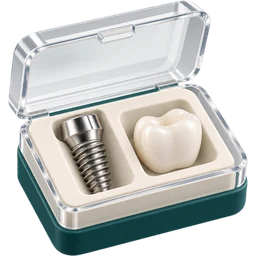
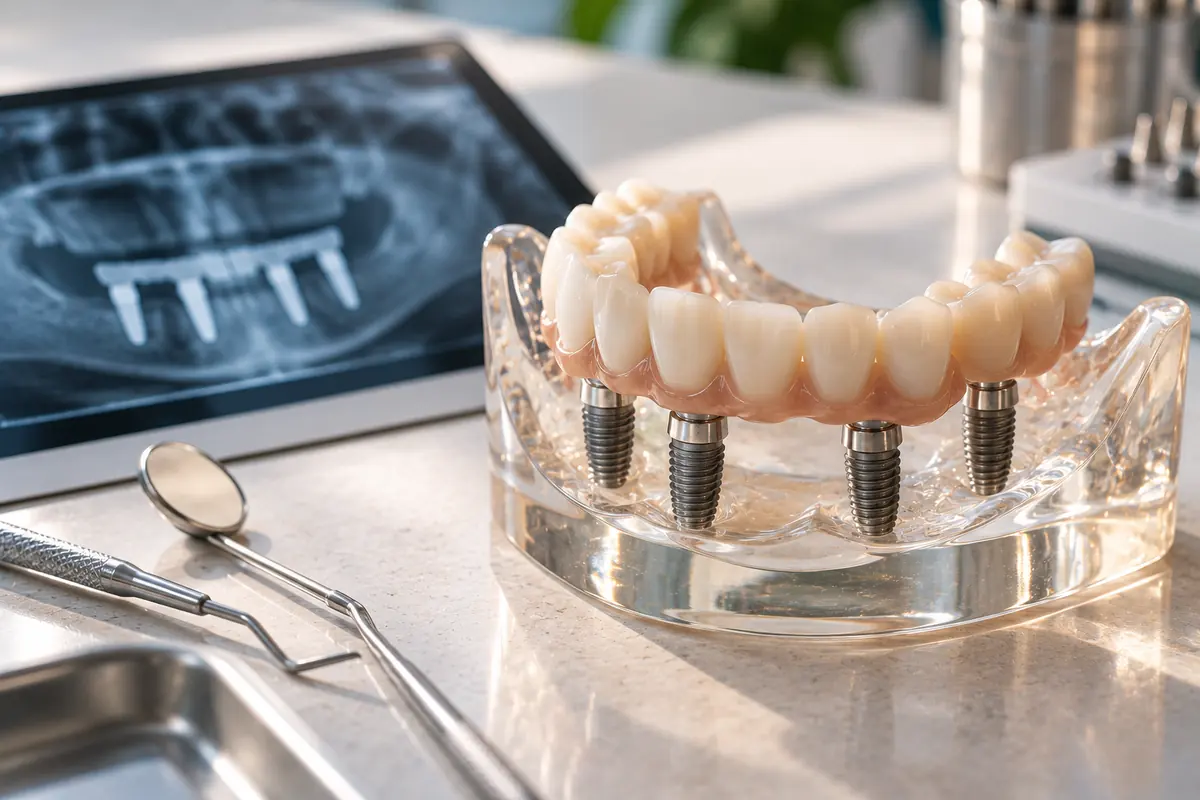
“All-on-4” is a brand name for a way of replacing a whole jaw of teeth with a fixed bridge held by about four implants. The general term is a full-arch fixed implant bridge. It can give a fixed set of teeth to someone with very little healthy tooth left, but it is a major, long-term commitment with mechanical and gum problems that should be expected and managed.
Fast results are often advertised. The sensible questions are about what happens in year two, five and ten, and who looks after the bridge.
What patients are quoted
We are collecting anonymous quotes for this treatment. Figures appear here once at least ten quotes are in.
Share the price you were quoted. It is multiple choice only and asks for no personal details. How the figures are calculated.
At a glance
- Can it be undone?
- Removing your remaining teeth cannot be undone.
- How long?
- Temporary teeth within about a day; the final bridge after healing.
- Evidence figure
- 81.3% biological and 38.8% mechanical complications over 5 years in one study, most minor.
- Ask first
- Who repairs the bridge, and where?
What a full-arch fixed implant bridge is
In this approach a whole row of teeth is made as one fixed bridge and attached to a small number of implants. “All-on-4” is a registered trademark of Nobel Biocare. The concept uses four implants, with the two at the back usually angled so that they can be placed in available bone and avoid the sinus (upper jaw) or the nerve canal (lower jaw). Many clinics use the same idea with five or six implants under names such as “All-on-X”, “All-on-6” or “teeth in a day”.
A temporary bridge is often fitted within about 24 hours of surgery. A final bridge is made later, after the implants have bonded with the bone. In some cases the remaining teeth need to be removed first.
Why the name matters. “All-on-4”, “All-on-X” and “teeth in a day” are marketing and technique names, not a guarantee of any particular standard. Ask which implant system, how many implants and which material the final bridge uses.
Who it may suit, and the alternatives
- People who have lost most or all teeth in a jaw, or whose remaining teeth are very badly damaged by decay or gum disease.
- People where bone loss would otherwise rule out standard implants or need bone grafting. Angled implants are a way of using the bone that is there.
- Patients still need enough bone and good general health. Smoking, uncontrolled diabetes and untreated gum disease raise the risk of implant problems.
Alternatives to ask about: a removable full denture; an implant-retained removable overdenture (clips onto implants); a fixed bridge on more implants; or keeping and treating some of your own teeth. A fixed bridge is not automatically the better choice. Cleaning under it takes effort, and repairs can be complex.
Typical stages
- Assessment and planning.Examination, X-rays and a 3D CBCT scan, a bite assessment and a written plan. Treatment planned from photos alone is not firm.
- Extractions and surgery.Teeth that cannot be kept are removed and the implants placed, often at the same visit, usually with sedation or general anaesthetic.
- Temporary bridge.Often fitted within about a day. It is not the final bridge and must be treated gently.
- Healing.Typically several months while the implants bond with the bone. This is why a single week is not enough for the whole treatment.
- Final bridge.Made and fitted after healing, with checks of the bite and cleaning access.
- Maintenance.Regular reviews, professional cleaning and checks of screws and the bridge material.
Risks, and what the evidence says
Reported survival is generally high but most long-term data comes from specialist centres, and complications are common. Two examples:
- A five-year prospective study of 80 fixed full-arch implant-supported metal-ceramic prostheses (65 patients, one clinic, one operator) reported implant survival of 99.8% and prosthesis survival of 98.8%. Even so, biological complications such as mucositis occurred in 81.3% of restorations, peri-implantitis in 13.8%, and mechanical or technical complications in 38.8%, most commonly a lost screw-hole filling, fractured porcelain and loose screws. Most were minor (about an hour of chair time or less).
- A general summary of the All-on-4 concept reports implant success of about 94.8% and prosthesis survival of about 99.2% in the lower jaw to 10 years, notes that most long-term data comes from the originating group, and says reviews call for more independent studies. Mechanical problems, especially breakage of the acrylic prosthesis, are the most common complication, and many can be fixed by repairing or replacing the prosthesis.
| Risk | What it means for you |
|---|---|
| Implant failure | One or more implants may fail to bond or be lost later. A good plan says what happens next and who pays. |
| Gum and bone inflammation | Common. Needs daily cleaning under the bridge and regular professional care. |
| Bridge breakage and wear | Acrylic teeth can fracture or wear and screws can loosen. Repairs may need the bridge to be removed. |
| Speech and cleaning difficulty | A fixed bridge can change speech at first and food can collect underneath. |
| Irreversibility | Removing your remaining teeth cannot be undone. Get a second opinion before extractions of teeth that might be saved. |
Questions to ask before you agree
Tap a question to copy it, then paste it into a message or an email.
Full-arch checklist
Tick items off as you complete them. Your ticks stay in this browser only.
Before you book in Türkiye
The same checks apply whichever treatment you choose. Each links to a full guide.
- Check the authorisation. Make sure the clinic, and any agency, holds a Ministry of Health authorisation for international patients. How to verify it
- Get the plan in writing, tooth by tooth. It should name the treatment, materials and brands for each tooth, and the full price. Questions to ask
- Read the guarantee before you pay. Find out what it covers, for how long and who pays for travel if something needs fixing. Guarantees
- Know what you are agreeing to. You have the right to clear information about risks and alternatives before you consent. Informed consent
- Take your records home. Ask for X-rays, scans and a written summary, including implant brands and sizes. Dental records
- Plan aftercare before you go. Find a dentist at home who will see you for checks and problems. Follow-up care
- Know where to turn if things go wrong. Complaint routes
Frequently asked questions
Can I get a whole new set of teeth in one day?
A temporary fixed bridge may be fitted within about a day of surgery. The final bridge comes after healing, usually several months later.
Is All-on-4 better than All-on-6?
No source we reviewed settles that. The number of implants depends on your bone, bite and the planned bridge. Ask why your number was chosen.
Will I need bone grafting?
One reason for angled implants is to avoid it, but some patients still need it. Ask for the scan and an explanation.
How long will it last?
No promise can be made. Studies report high survival, but also frequent maintenance and repairs. Plan for maintenance for life.